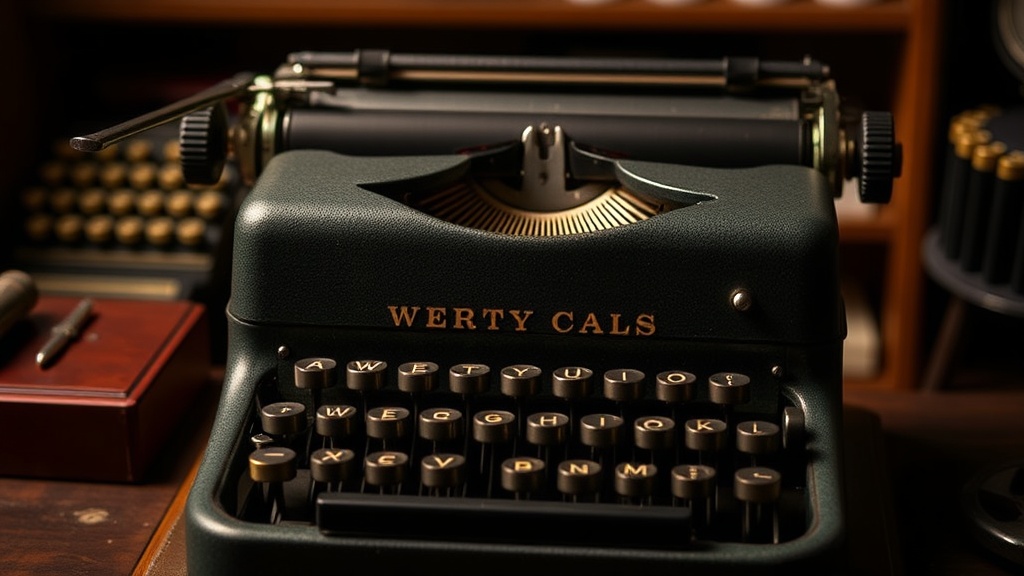
Dating Your Vintage Typewriter: A Practical Guide to Serial Numbers and Design Features

Over 400 million manual typewriters were manufactured worldwide between 1874 and the mid-1980s — yet fewer than 1% of surviving machines retain their original sales receipts or documentation. That leaves most collectors squinting at serial numbers, comparing font styles, and decoding manufacturer stamps to figure out when their machine actually rolled off the assembly line. Knowing your typewriter's age isn't just trivia — it affects value, parts compatibility, and whether that "rare find" is actually a common model dressed up in aftermarket paint.
This guide walks you through the practical methods collectors use to date vintage typewriters without guesswork. You'll learn how to locate and interpret serial numbers, recognize era-specific design features, and cross-reference findings against manufacturer records. No specialized tools required — just patience, good lighting, and a willingness to get acquainted with your machine's physical history.
Why Do Serial Numbers Matter for Dating Typewriters?
Serial numbers are the closest thing to a birth certificate your typewriter possesses. Most manufacturers — from Royal and Underwood to Remington and Smith-Corona — maintained sequential numbering systems that tracked production runs across factories and years. These numbers weren't random; they followed patterns that collectors have spent decades mapping through factory records, trade publications, and surviving company archives.
Locating the serial number varies by manufacturer. On most portables, you'll find it stamped into the frame beneath the ribbon cover or on the bottom plate. Standard office machines often display numbers on the back panel or carriage base. Look for raised metal stamps rather than printed labels — the latter are usually dealer inventory tags or aftermarket additions that won't help with dating.
The challenge? Manufacturers sometimes reused number ranges across different models or maintained separate sequences for domestic and export production. Royal's portable line, for instance, used distinct numbering for machines bound for European markets versus North American distribution. A 1940s Royal Quiet De Luxe might carry a serial that looks identical to a 1950s variant — which is why physical features matter just as much as the numbers themselves.
What Physical Features Reveal a Typewriter's Manufacturing Era?
Serial numbers tell part of the story, but design evolution fills in the gaps. Typewriter manufacturers updated their machines constantly — not just for aesthetic reasons, but to reduce production costs, accommodate new materials, and respond to competition. These changes create datable "fingerprints" across different production periods.
Keyboard layouts shifted dramatically in the 1930s and 1940s. Pre-1930s machines often featured three-row keyboards with 28-32 characters. The four-row standard (QWERTY with number row) became universal by the late 1930s, though some budget models retained older layouts into the 1950s. If your machine lacks dedicated number keys above the letters, you're likely looking at something manufactured before World War II.
Platen material changed with rubber rationing. During WWII, steel and rubber shortages forced manufacturers to experiment with wooden platens (the rollers that feed paper through the machine). These wooden alternatives didn't age well — most cracked or warped within decades — so finding one intact is rare. Post-war machines returned to rubber-coated steel platens, though quality varied through the 1950s as manufacturers optimized for cost.
Paint finishes evolved with industrial technology. Early typewriters (pre-1930s) typically featured japanning — a baked enamel finish that created deep, glossy black surfaces prone to chipping but resistant to rust. The 1940s and 1950s brought wrinkle and crinkle finishes (textured paint that hid imperfections), while the 1960s saw the rise of smoother, cheaper enamel and eventually plastic panels on budget models. Color also matters: two-tone schemes peaked in the 1950s, while the avocado and harvest gold craze of the late 1960s and 1970s signaled declining build quality as manufacturers chased fashion trends.
Carriage design offers additional clues. Round, open carriages with visible springs and mechanisms dominated early production. By the 1950s, streamlined enclosures hid these components for a "modern" look. The shift from metal to plastic control knobs and paper supports accelerated in the 1960s — a clear indicator of manufacturing date even when serial records are ambiguous.
How Can You Cross-Reference Serial Numbers with Manufacturer Records?
Finding the serial number is step one; matching it to a production date requires reference materials. Several collectors and historians have compiled manufacturer-specific databases that transform cryptic numbers into calendar years.
The Typewriter Database maintained by Xavier University collects serial number ranges across major brands, though coverage varies by manufacturer. For Royal machines specifically, the Royal Typewriter Company Historical Society maintains production records extending back to 1906. Underwood collectors often reference Paul Robert's Typewriter Database, which crowdsources serial numbers from owners worldwide to refine dating accuracy.
When consulting these resources, record not just the serial number but the model name and any factory codes visible on the machine. Two-letter stamps (often found near the serial number) frequently indicate manufacturing location — "NY" for New York, "HT" for Hartford, "TO" for Toronto. These codes help narrow down which production sequence your machine followed, as manufacturers sometimes ran parallel numbering at different facilities.
Be prepared for ambiguity. War production, factory transitions, and corporate mergers (like Smith-Corona's acquisition of Marchant in 1958) created overlapping serial ranges and mixed components. A 1943 machine might carry a 1942 frame with updated 1943 parts. The goal isn't pinpoint accuracy to the month — it's establishing a reliable five-year window that informs valuation and restoration decisions.
Red Flags That Suggest Modified or Franken-Machines
Not every typewriter wears its original configuration. Collectors sometimes encounter "Franken-machines" — hybrids assembled from parts spanning different decades. These are usually well-intentioned repairs rather than deception, but they complicate dating efforts.
Check for mismatched paint colors between the body and carriage — a sign that components were swapped. Examine screw heads: mixed slot and Phillips head screws suggest repairs using hardware from different eras. Original factory screws were uniform within production periods. Finally, compare the serial number font against known examples; stamped numbers should match the manufacturer's typical style and depth. Laser-etched or poorly stamped additions are modern additions.
Building Your Own Dating Documentation
Once you've established your typewriter's approximate age, document your findings. Photograph the serial number location, keyboard layout, and distinctive features. Create a simple record sheet noting the manufacturer, model, serial number, estimated production date, and your reasoning. This documentation proves invaluable if you ever sell the machine — buyers appreciate provenance, even when it's research-based rather than receipt-backed.
Consider contributing your findings to online databases. Every verified serial number helps refine dating accuracy for the collector community. The Typewriter Database accepts submissions with photographs, and many manufacturer-specific forums maintain running threads where owners share discoveries and debate ambiguous cases.
Remember that dating your typewriter serves practical purposes beyond curiosity. Knowing the manufacturing era helps you source correct replacement parts — a 1930s ribbon spool won't fit a 1960s mechanism. It informs appropriate cleaning methods — japanning responds differently to solvents than later enamel finishes. And it protects you in the marketplace, where sellers occasionally misrepresent common machines as rare wartime production or vice versa.
The hunt for manufacturing dates connects you to a machine's tangible history — the factory where it was built, the hands that assembled it, the era it survived. Every serial number represents a specific moment in industrial history. Learning to read them transforms anonymous metal objects into time-stamped artifacts with stories worth preserving.