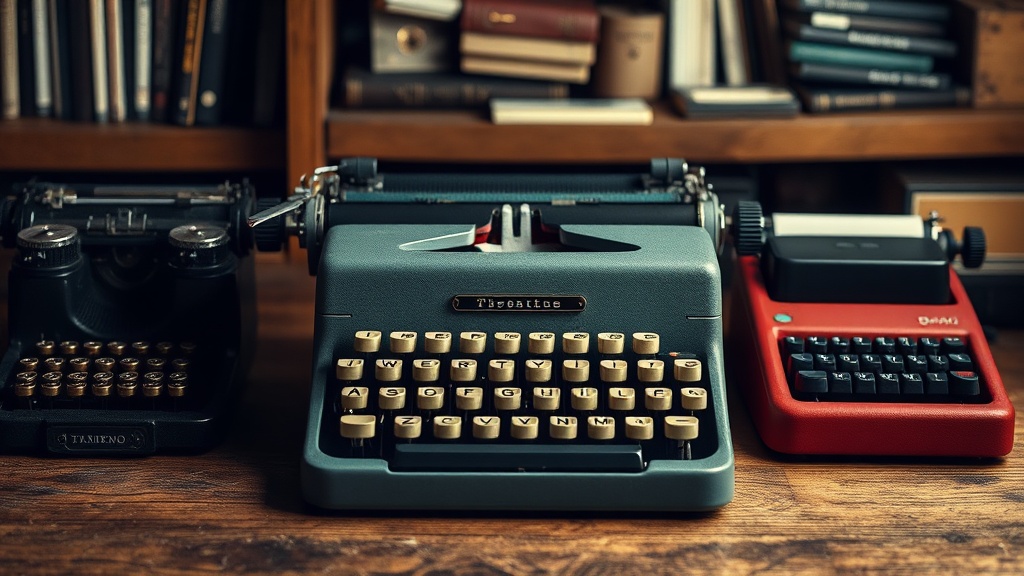
Seven Typewriter Collector Archetypes: Which One Are You?

What Drives People to Fill Their Homes with Decades-Old Writing Machines?
Walk into any estate sale in a quiet neighborhood and you'll spot them—the folks hovering over dusty Underwoods and Olympia SM3s, running their fingers across chrome carriage returns and testing key action with knowing nods. These aren't random shoppers looking for a quirky paperweight. They're collectors, and they each have a story (and a strategy) driving their obsession. This isn't about hoarding old metal boxes—it's about preserving mechanical ingenuity in an age of disposable electronics. Whether you've got three typewriters tucked on a shelf or thirty crowding your garage, understanding your collector archetype helps you build a more intentional, satisfying collection.
The vintage typewriter market has exploded over the past decade. What once sold for pocket change at garage sales now commands serious prices on eBay and specialized auction sites. A pristine 1930s Royal Portable might set you back several hundred dollars; rare models like the Oliver No. 5 with original documentation can fetch thousands. But money alone doesn't define a collector. The real distinction lies in what draws you to these machines—the hunt for historical significance, the satisfaction of mechanical restoration, or simply the aesthetic pleasure of mid-century industrial design.
What Makes the Era Purist Tick?
The Era Purist doesn't just collect typewriters—they collect decades. Walk into their home and you'll find a chronological display: a pre-1920s understroke machine sits beside a simplified 1930s portable, followed by a chunky 1950s office standard. These collectors believe typewriters tell the story of industrial design evolution better than any textbook.
Era Purists obsess over context. They research what writers were using during specific historical moments—Hemingway's Underwood, Kerouac's scroll-fed Royal, Cormac McCarthy's Olivetti. They collect period-appropriate accessories: original shipping crates, vintage typing paper, even the instruction manuals with their charming period illustrations. The challenge here is patience. Finding a 1915 Smith Premier in working condition takes months of hunting. You can't rush an Era Purist collection—you have to wait for the right decade to surface.
The payoff comes in the narrative. These collectors become amateur historians, tracing how the shift from cast iron to stamped steel reflected broader manufacturing changes, or how simplified Art Deco designs gave way to the stark functionalism of postwar models. Their collections become time capsules, each machine a portal to a specific moment in the twentieth century.
The Appeal of Specific Decades
Most Era Purists gravitate toward particular periods. The 1920s and 1930s offer some of the most visually striking machines—chrome accents, glossy paint, and mechanical innovations that bridged the gap between pure function and industrial art. The Royal Portable introduced in 1926 exemplifies this golden age: portable enough for traveling salesmen, beautiful enough for the parlor.
Collectors focused on the 1950s and 1960s encounter a different aesthetic—pastel colors, curved lines, and the last gasp of mechanical innovation before electric models took over. These machines often feel more approachable to newcomers. They're plentiful, relatively affordable, and their bold colors (mint green, salmon pink, powder blue) photograph beautifully for social media posts.
Why Do Some Collectors Focus Exclusively on One Brand?
Brand Loyalists commit to a single manufacturer with the devotion of sports fans. They own six different Olympia models—not because they need six typewriters, but because they need to understand how Olympia's engineering evolved from the 1930s SM3 through the 1960s SM9. They know which serial number ranges indicate West German versus Mexican assembly. They can spot a refurbished machine by subtle differences in the logo placement.
This archetype tends to attract mechanically-minded collectors. Focusing on one brand means encountering consistent design philosophies and engineering solutions. A Royal Loyalist learns the company's signature features: the Magic Margin system, the spring-loaded key action, the distinctive "Royal" font. They become experts in that manufacturer's quirks, able to diagnose problems by sound alone.
The downside? Brand Loyalists risk missing out. A devoted Smith-Corona collector might walk past a pristine 1950s Olivetti because it doesn't fit the collection's theme. The upside? They build unparalleled expertise. When a rare variant surfaces—a Royal Quiet De Luxe in an unusual color, or an export-only Olympia with QWERTZ layout—they recognize it immediately and know exactly what it's worth.
Notable Brand Loyalty Patterns
Olivetti attracts design enthusiasts drawn to the company's collaboration with architects and artists. The Lettera 22 (designed by Marcello Nizzoli) and the Valentine (by Ettore Sottsass) transcend their utilitarian function to become design icons. The Museum of Modern Art displays several Olivetti models, cementing their status as functional sculpture.
German manufacturers—Olympia, Adler, Triumph—appeal to collectors who prize engineering precision. These machines often outlast their American counterparts, with tighter tolerances and more strong construction. The downside? They're heavier, and replacement parts can require international sourcing.
How Do Repair Specialists Build Their Collections?
Repair Specialists approach collecting as a rescue mission. They haunt estate sales and thrift stores looking for "basket cases"—machines seized with rust, missing parts, or decades of accumulated grime. Where other collectors see damage, they see potential. Their shelves hold partially disassembled machines in various stages of rehabilitation, each representing a puzzle to solve.
This archetype requires mechanical aptitude and patience. A frozen carriage might need nothing more than degreasing and relubrication—or it might require fabricating a replacement part from scratch. Successful Repair Specialists accumulate specialized tools: pin punches, spring hooks, ultrasonic cleaners for small components. They build networks with other collectors, trading parts cannibalized from irreparable machines to keep salvageable ones running.
The satisfaction here differs from other archetypes. A mint-condition machine purchased at full retail brings no particular thrill to the Repair Specialist. But a $15 garage sale find that coughs back to life after three weekends of careful work? That's the addiction. These collectors often sell restored machines to fund their habit, maintaining a rotating inventory that keeps their hobby self-sustaining.
The Learning Curve for Restoration
Newcomers to this archetype should start simple. A 1950s portable with stuck keys teaches you about segment cleaning and spring tension without the complexity of an early-century understroke mechanism. Online communities like the r/typewriters subreddit offer troubleshooting advice, but hands-on experience remains the best teacher. Every machine presents unique challenges—corrosion patterns vary based on storage conditions, and previous "repairs" often create new problems.
What About the Aesthetic Collector?
Aesthetic Collectors prioritize appearance over function. They're drawn to color, condition, and display potential. A machine that types poorly but looks stunning on a bookshelf beats a workhorse office model every time. These collectors curate their machines like gallery installations, arranging them by color gradient or design era.
This approach generates criticism from purists who believe typewriters exist to be used. The Aesthetic Collector shrugs. They appreciate these machines as industrial art objects, mechanical sculptures that happened to produce words. Their collections spark conversations, serving as striking visual anchors in homes where design matters more than vintage office equipment.
The Aesthetic Collector has driven up prices for colorful mid-century portables. A beige 1950s Royal might sell for $75; the same model in mint green or coral pink commands $300 or more. Condition becomes most important—original paint matters, touched-up surfaces diminish value, and chrome must gleam. These collectors learn to spot reproduction ribbons and non-original cases, insisting on authenticity even when function isn't the priority.
Which Archetype Suits You Best?
Most collectors blend these categories. You might primarily chase 1940s machines while maintaining a soft spot for anything turquoise. You might focus on Hermes models but occasionally rescue a battered Corona just for the restoration challenge. The archetypes aren't restrictive boxes—they're tendencies, gravitational pulls that shape your hunting habits and display choices.
The key lies in self-awareness. If you gravitate toward repair projects, budget for tools and parts storage. If you're an Era Purist, invest in research materials and display space that allows chronological arrangement. Brand Loyalists should join manufacturer-specific communities where rare variants get discussed. Aesthetic Collectors need to develop an eye for original condition and learn to walk away from repainted machines masquerading as mint.
Typewriter collecting rewards the patient and curious. Whether you're drawn to engineering precision, historical significance, mechanical problem-solving, or pure visual pleasure, there's a community of similarly obsessed collectors ready to share knowledge and enable your next acquisition. Start with what speaks to you, learn everything you can about your specific interests, and resist the urge to buy everything shiny that crosses your path. The best collections grow deliberately, each machine earning its place through some combination of rarity, condition, personal significance, or sheer mechanical charm.