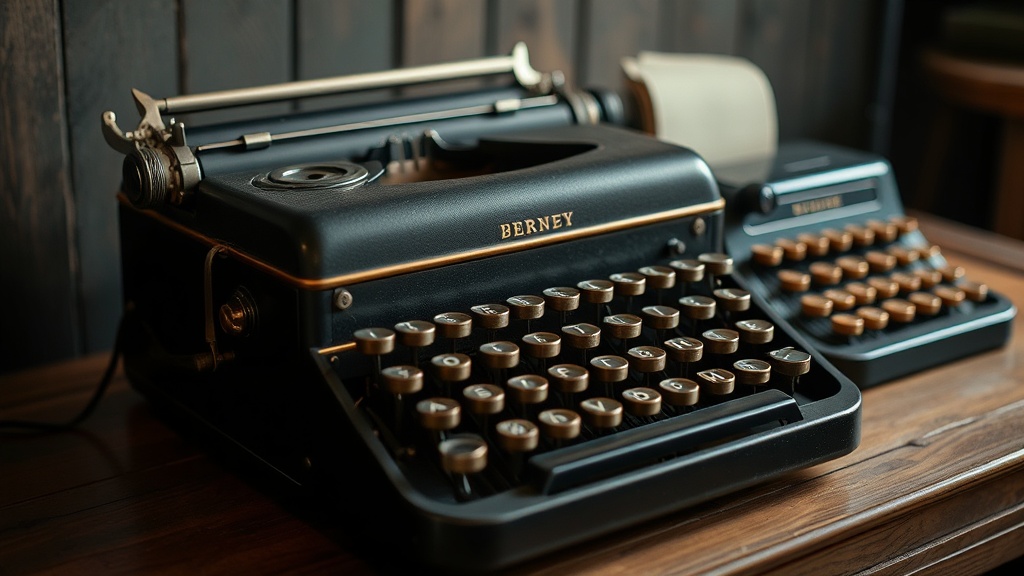
The Golden Age of Typewriters: Why Collectors Still Chase These Mechanical Marvels

This post explores what makes typewriters from the 1920s through 1960s so desirable to collectors today, why prices continue climbing at estate sales and online auctions, and how to spot a machine worth restoring versus one destined for parts. Whether hunting for a first acquisition or adding to an established collection, understanding the market dynamics and restoration basics will save both money and disappointment.
What Makes a Typewriter "Golden Age" and Worth Collecting?
The Golden Age spans roughly 1920 to 1960, when manufacturers perfected the mechanical typewriter before electric models took over. Machines from this era represent the pinnacle of analog engineering—each key press triggers a complex ballet of levers, springs, and typebars that transfer ink to paper with satisfying precision.
Collectors chase these machines for several reasons. The build quality is unmatched—many surviving units weigh 15 to 25 pounds of solid steel and cast iron. They're repairable. A 1930s Underwood No. 5 can still be tuned up with basic hand tools and patience. Try fixing a 1990s electronic word processor with a failed circuit board.
The aesthetics matter too. Chrome accents, glossy enamel finishes in forest green or burgundy, glass-topped keys with perfect typography—these details make Golden Age machines display-worthy even when not in use. The Olympia SM3 in seafoam green sits on many collectors' grail lists for good reason.
Condition drives value more than age. A battered 1920s machine missing its ribbon cover and plagued by frozen typebars might sell for $40 at a garage sale. The same model, fully restored with new felt pads and a fresh platen, commands $400 or more at specialty shops like Mr. Typewriter.
Which Brands and Models Hold Their Value Best?
Certain manufacturers consistently outperform the broader market. German makers Olympia and Merz & Kienzle built machines with tighter tolerances and superior engineering that survive decades of use. American stalwarts Underwood, Royal, and Smith-Corona produced millions of units, but their premium lines—particularly portable models from the 1950s—remain highly sought after.
Here's how key models compare for collectors considering different entry points:
| Model | Era | Weight | Typical Price (Good Condition) | Best For |
|---|---|---|---|---|
| Underwood No. 5 | 1920s-1930s | ~18 lbs | $150-$350 | Display piece, occasional typing |
| Royal Quiet De Luxe | 1940s-1950s | ~16 lbs | $200-$450 | Daily writing, portability |
| Olympia SM3 | 1950s-1960s | ~13 lbs | $300-$600 | Serious typing, script fonts |
| Hermes 3000 | 1960s-1970s | ~12 lbs | $400-$800 | Professional restoration projects |
| Smith-Corona Skyriter | 1950s | ~11 lbs | $180-$320 | Travel, ultraportable use |
The Hermes 3000 deserves special mention. Featured prominently in films and favored by writers including Jack Kerouac, this Swiss-built portable combines precision engineering with distinctive styling. Prices have climbed steadily—machines that sold for $150 a decade ago now regularly fetch $500-plus at auction.
Japanese manufacturers like Brother and Nakajima produced excellent machines in the 1960s and 1970s, often overlooked by collectors chasing European or American names. The Brother Deluxe 1300 offers exceptional value—well-built, readily available, and typically priced 30-40% below comparable Western models.
How Do You Spot a Typewriter Worth Restoring?
Not every dusty machine at the thrift store deserves rescue. The catch? Some problems cost more to fix than the finished typewriter will ever be worth.
Start with the basics. Check that the carriage moves freely—frozen carriages often indicate rusted escapement mechanisms, a repair requiring complete disassembly. Press a few keys. Typebars should strike the platen crisply and return without sticking. Bent or twisted typebars can sometimes be straightened, but missing type slugs (the actual letter stamps) mean hunting for donor parts.
Inspect the platen—that rubber roller behind the carriage. It should feel firm, not rock-hard or crumbling. Replacing a platen costs $75-$150 through specialists like JJ Short Associates. Worth doing on a valuable machine, less sensible on a common beater.
Look for completeness. Missing ribbon covers, paper supports, or spools reduce value and can be difficult to replace. That said, reproduction parts exist for popular models—3D-printed paper supports for Royal portables, reproduction ribbon covers for Underwoods. The restoration community has grown resourceful.
Test the mechanics even if you can't type. Manually advance the carriage—resistance suggests dried grease or worse. Flip the machine (carefully—remember, 20 pounds of metal) and peer underneath. Surface dust wipes away. Heavy rust, missing screws, or cobbled repairs tell a different story.
Red Flags That Should Send You Walking
- Cracked or chipped cast iron frames—these cannot be practically repaired
- Severely bent typebasket (the semi-circular arrangement of typebars)
- Missing serial number plates, often indicating stolen goods or Frankenstein machines built from mismatched parts
- Evidence of water damage—rust blooms inside the mechanism where you can't see it yet
- Locked-up segment (the slots where typebars pivot)—freeing these requires complete teardown
Green Lights for First-Time Restorers
- Smooth carriage movement with intact drawstring or mainspring
- All typebars present and mostly straight
- Original case in any condition—cases alone sell for $50-$100 separately
- Decals and badges intact—these authenticity markers matter to serious collectors
- Little or no "zigzag" typing when tested—indicates proper alignment
Where Does the Typewriter Market Stand in 2026?
The collecting space has shifted dramatically over the past decade. What began as nostalgia-fueled interest has matured into a strong secondary market with dedicated auction houses, restoration services, and even typewriter rental businesses for weddings and events.
Estate sales in older neighborhoods—particularly in cities with manufacturing histories—remain prime hunting grounds. Edmonton itself saw several significant collections surface last year when longtime collectors downsized. The key is building relationships with estate sale companies and arriving early. The best machines rarely make it to afternoon discount periods.
Online marketplaces require more caution. eBay prices often run 40-60% higher than local finds, and shipping presents genuine risks—a dropped package can destroy alignment in ways that take hours to correct. Facebook Marketplace and Craigslist reward patience and quick responses. Set alerts for "typewriter," "vintage typing," and specific model names.
Specialty dealers like Gramercy Typewriter Company in New York or Uwe's Vintage Typewriters in California offer fully serviced machines with warranties. You'll pay premium prices—often $400-$800 for restored portables—but the peace of mind matters for collectors prioritizing function over the hunt.
Investment Considerations (If You Must)
Collecting should bring joy first. That said, certain segments show consistent appreciation:
- Mid-century portables in unusual colors—pastel Royals, two-tone Smith-Coronas, anything in mint or coral
- Pre-WWII German machines—engineering excellence plus scarcity as wartime destruction claimed many units
- Working examples with original documentation—manuals, sales receipts, even the original purchase boxes multiply desirability
- Specialized variants—machines with mathematical symbols, uncommon keyboard layouts, or foreign character sets
Avoid "investing" in common post-1970s electrics or plastic-bodied portables. The IBM Selectric—revolutionary in its day—remains relatively affordable because so many were produced. They're fascinating machines (that rotating typeball!), but unlikely to appreciate significantly.
Building a Collection That Matters
The most satisfying collections reflect personal curiosity rather than market trends. Some collectors specialize by manufacturer—every significant Royal model from 1925 to 1965. Others chase aesthetic variations, filling shelves with machines in every color of the enamel rainbow. A few focus on utility, maintaining working typewriters for actual writing projects.
Community accelerates learning. The Edmonton Typewriter Club hosts monthly meetups where members trade restoration tips, show off recent finds, and—yes—actually type on their machines. Online forums like the Typewriters 101 community connect isolated collectors with expertise spanning nearly every model ever manufactured.
Start with one good machine. Learn its quirks. Type a few letters, a short story, a manifesto. The physical act of striking keys, hearing the mechanism respond, watching letters accumulate on paper—it explains the obsession better than any collector's guide. The right typewriter doesn't just sit on a shelf looking pretty. It waits, patient and mechanical, for the next burst of creativity.